
The EMRIG members set out on Sunday the 30th of August 2015 to visit Helgard Meyer’s HO scale SAR layout. As is normal, one is uncertain as to what to expect. We have seen a good number of layouts recently, all different and simply amazing. Surely those could not be beaten. Well this one arguably did just that. This is one layout visit you attend where you just wish you had brought a dictaphone!
The layout is relatively small being about 3m X 4m, with wonderful scenery. However, what set this layout apart from the rest was the history. Helgard undoubtedly enjoys and loves his local history, much of which he seems to have been intricately involved with. Helgard has commissioned a number of people to help him build his dream, who will be discussed later; however, he had the most amazing vision which these helpers were to follow. He wanted 4 independent scenes based on real history he was associated with.

Then there is the South African Air Force Memorial with an outside parade. To match this was also an accompanying audio of a military band playing. Helgard pulled out the “record” of the audio clip, telling everyone which one it was as well as its history.
Then it was over to the planes themselves. Helgard went into great detail about almost every plane in the scene. The South African Airforce is the second oldest air force in the world and the layout includes aeroplanes from the early 1920’s. Some of the EMRIG members associated with the planes and scenes and brought back fond memories. Again, to compliment the scene were sounds of fighter aircraft “screaming” through the air.

Then it was over to Helgard’s younger years with Queenstown station being modelled. In the photos there is a photo of two houses which when you look at them make you know they are railway houses. The whole scene resembled one of the train towns of the old South Africa.
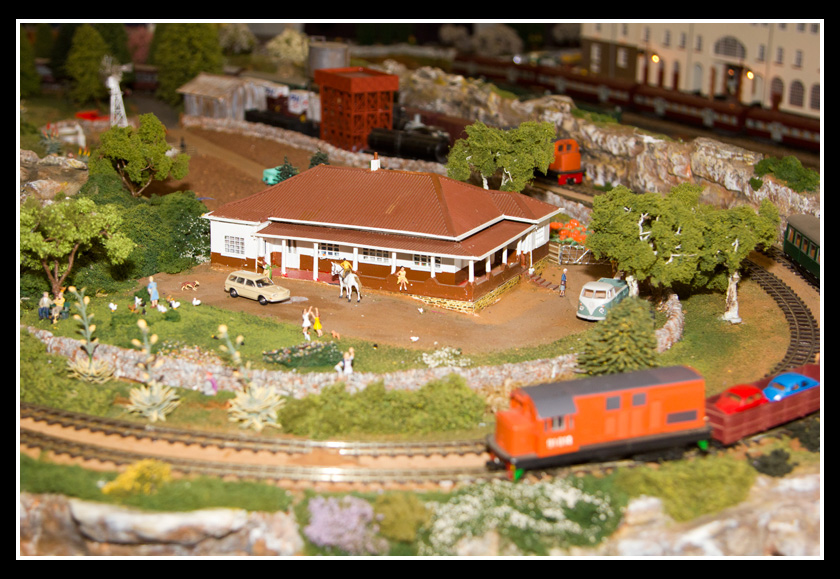
Then there were the actors, the trains. All again, were based on prototypical trains, one such being the “White Train”. Helgard went into great detail explaining the history of this train and more specifically the Royal Visit in 1947.

However, for Helgard, the very first “vivid” memory of the “White Train” was when it was used to transport the remains of the then Prime Minister of South Africa “Adv Johannes Gerhardus Strijdom”, who died in 1958. After a memorial service in Cape Town his body was transported to Pretoria on the White train which stopped at most stations, where a small orchestra moved out of the train and played the national anthem while onlookers sang and paid their last respects! His “coffin” was draped in the national flag and he was finally buried in Pretoria. Just imagine what Helgard witnessed!
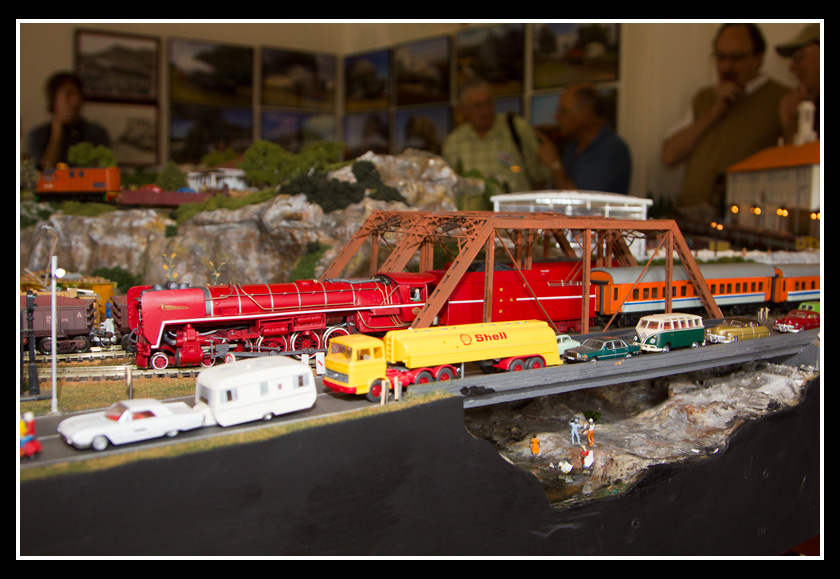
Obviously other trains included the old and new Blue trains, the metro sets as well as an Iron ore hauler together with mid train and rear train helpers. Diesel loco’s, electric locos and steam. The whole layout and environment were rich in history, ably told by Helgard.

There was a lot of animation on the layout with a helicopter and rotating rotors mentioned above, children on a see-saw moving up and down, chickens pecking at the ground for their food, a cow who’s head was moving from side to side, Eagles flying in a ravine with their nest on a ledge, to a car, crashed over the railing with the skid marks and all.
Helgard mentioned many times the folk that made all this happen, in particular Diederick and Colin who were the main contributors.
As mentioned, Albert Borgstein built the Pretoria station. All the steam engines were built by Eric Bekker from Mosselbay. Lourens Sturgeon built the 4E, 9E, 14E, 15E electrical locomotives. Chris van der Walt from the Aviation shop did the painting of most of the aeroplanes, also the Paul Kruger locos, the Gautrain, the trams and buses and many other items. Diederick van Rensburg built the lay-out over a 6 month period including all the landscaping as well as the farmhouse. Colin did all the electrical engineering and both John Burkhardt and Colin fitted the sound chips. Lastly, Jean Dulez’s book provided the inspiration to turn the layout into both a “historic and nostalgic” layout!
This article will just never do the visit justice. Hopefully one day in the future, Helgard will allow the club back for another visit. If that happens, don’t think about it, jump at the opportunity! You will not regret it.
Many more photos below.
Till next time.




Recent Comments